Walter Rane: THE GOOD SAMARITAN

THE STORY: Walter Rane illustrates Jesus's parable of the man who fell among thieves and is left for dead at the
side of the road. Both a priest and a Levite pass by him, but a
Samaritan—part of a despised sect—feels compassion for him. Luke tells
us that the Samaritan “went to him, and bound up his wounds, pouring in
oil and wine, and set him on his own beast, and brought him to an inn,
and took care of him” (Luke 10:34).
ANALYSIS: Rane captures fleeting moments in his painting. In this, we see the moment when the Samaritan
first checks on the battered man. The Samaritan tilts the injured man’s head
back and gently touches his face with an expression of concerned
kindness. This is the moment that “he had
compassion on him.”
The injured man is shown unconscious, stripped of his
clothing, and dotted with blood. His recumbent position echoes a
traditional pose in art for the dead Christ, similar to the pose in
Michelangelo’s Pieta (and many other Pietas).

See the similarity in the pose of the crucified Christ and the injured man in the Good Samaritan? This pose has been used by many artists to indicate a martyr or innocent suffering. Here's The Death of Marat, by Jacques Louis David, showing the murder of a revolutionary hero:

And Picasso uses it in his anti-war mural protesting the bombing of Guernica. Here's the mural and a close-up:
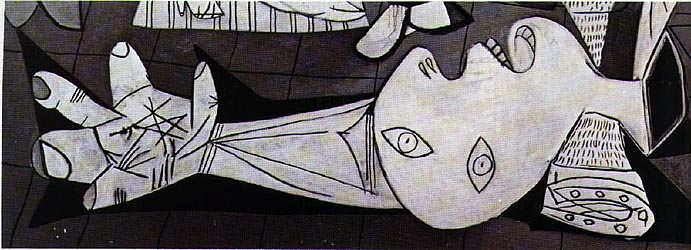

By echoing the traditional pose and dress of the crucified Christ, Rane draws a connection between Jesus Christ and the beaten man. The question that prompted this parable was "Who is my neighbor?" (Luke 10:25). The answer Rane has painted reminds the viewer of the Savior’s teaching: “Inasmuch as ye have done it unto the least of these my brethren, ye have done it unto me” (Matthew 25:40).
Christ is also reflected in the Good Samaritan. His beard, dress, and particularly the kind expression on his face remind us of other paintings of Jesus Christ.
The injured man's face tilts away from the viewer, and the Samaritan's face is mostly shielded by the headdress he wears. Their bodies and their hands are the focus of the painting, not their faces. The misfortune that has befallen the victim is clear from his injuries and stripped body. The compassion that the Samaritan shows are expressed in his hands, cradling and caring for the injured man.
PERSONAL IMPACT: Studying this painting prompts numerous insights for me into a very familiar parable. The plot twist that shocked the Jews--that the despised Samaritan was actually the kind neighbor in this parable--applies today. OH HOW IT APPLIES TODAY. These are the stories that still warm my heart, when someone can transcend their prejudices to serve someone they might have little reason to love.
I love the gentleness we see in this painting. I also love that we see in Christ in both figures--the injured man and also the nurturing Samaritan who will use his own money and time to care for the man.


Comments
Post a Comment