Elspeth Young: TILL WE MEET AGAIN
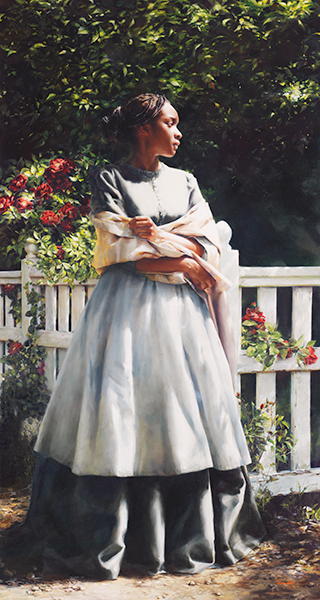
Copyright by Elspeth Young. All rights reserved. Courtesy of Al Young Studios.
THE STORY:
Jane Manning James is one of my favorite pioneers. She joined the church in Connecticut and led her family over 800 miles on foot to Nauvoo, where she worked for Joseph and Emma Smith.
This painting portrays her when Joseph Smith was killed. "This full-length portrait presents Manning as she might have appeared in the brilliant sunshine of that June day ('smitten and mourning' as one contemporary described Nauvoo's inhabitants), standing in the deathly hush as the creaking of the wagon bed moved slowly down the street, bringing home the marred and blood-stained bodies of Joseph and Hyrum. 'I liked to a died myself,' said Manning. "I will never forget that time of agony and sorrow."
"The moment in this painting is the moment when Manning, like everyone in Nauvoo, stood at a crossroads" (Al Young Studio).
THE ANALYSIS:
I loved the analysis from the artist's page, so here it is!
"While the darkness of the figure's dress signifies mourning, the colors of her outer wrap and work apron are inspired by the coloration of a mourning dove--symbolizing the Comforter as well as the hope and peace founded upon the resurrection.
"Much of the area of the painting is engulfed in shadow, like the darkness that combined in the martyrdom of Joseph and Hyrum Smith. And in that darkness, we can see nothing of home or comfort or security, nothing of the hopes and dreams that were embodied in the founding of the city of Nauvoo in 1840 on the eastern shores of the Mississippi.
"There is no gate in the fence by which to return to the past. And the sunshine in the painting is not just the sunlight falling like tears on the streets of the city; but it further represents the searing sunshine bathing boundless prairies and treeless deserts beyond the Rocky Mountains where many who watched that day, as Jane did, would either be buried or would bury their own loved ones in shallow, frozen, unmarked graves that only wolves would ever find. In that sense, the sunshine is also the same light by which night's curtain has been parted every day since then; days in which the great latter-day work begun by Joseph Smith has continued reaching out to fill the earth. And in that latter sense, not only the sunlight in the painting, but the gate-less fence, hems the darkness in. For all of the travails from that day to this are but the stirrings of the sunrise of the long-awaited Millennial Day toward which the prophets of all the ages have looked down.
"The sinuous vine of red roses trailing behind the figure--Rosa gallica--was indigenous to western Illinois at the time of the martyrdom. They symbolize the life of Joseph Smith, both for the glory and beauty of their bloom, as well as being a token of the traditional folk tune, "The Last Rose of Summer," listed among the Prophet's favorite songs by his good friend, Benjamin F. Johnson" (Al Young Studio).
And! And! The model for Jane Manning James, an early American pioneer, is the granddaughter of a modern West African pioneer. Read more about her here.
PERSONAL IMPACT:
I didn't learn about Jane Manning James until I went to BYU. I love her. What an example of faith and courage! Here's my favorite quote from her about crossing the plains: "Oh how I suffered . . . but in all, the Lord was with us and gave us grace and faith to stand it all" (Women of Character).
That's all we can really ask for, right? I think the idea that the Lord doesn't give us more than we can handle is utter nonsense. But I do believe the Lord can magnify us to rise to whatever challenges He gives us. Or, as Jane says, He'll give us grace and faith to stand it all.


Comments
Post a Comment